When we arrived in Turkey we had the benefit of a translator/tour guide. One one of our excursions together, he told us that there was a "new" Russian monument in Gelibolu. He gave us a vague idea where he thought it was located, but none of us could figure out why there might be a Russian monument in Turkey; that is until I recently found these two articles on line. So that solved the mystery of why but we still haven't located the monument. We've checked out a couple of cemeteries and explored some back streets but so far no luck. We could ask someone who lives in Gelibolu, but chances are they wouldn't know either.
http://www.russianorthodoxchurch.ws/synod/eng2008/5engallipoli2.html

PARIS: May 29, 2008
Communique of the Society of the Descendants of Gallipoli
Communique of the Society of the Descendants of Gallipoli
THE RESTORATION OF THE MONUMENT TO THE HEROES OF THE WHITE MOVEMENT OF GALLIPOLI
History:
In November, 1920, after the
evacuation of Crimea, parts of the White Movement crossed the Bosphorus
on 126 ships and arrived in Constantinople.
The soldiers were then assigned
to various temporary camps in Turkey. On November 22, the first parts
of the First Army Corps of the Russian Volunteer Army under General
Kutepov landed on the northern (European) coast of the Dardanelles
(now Gelibolu). Other portions of the military found hospice in other
places, the Cossacks on the Isle of Lemnos, while the Navy went to the
port of Bizert, Tunis.
The First Corps of the White
Army broke camp in Gallipoli by regiment (including the Drozdov Division
and the Alexeev Regiment), in a wide hardscrabble plain, where they
remained from November 1920 until mid-1923. In 1923, the last White
Army soldiers left Gallipoli. During the entire duration of their
stay, the Army retained its weapons and stayed with their attachments:
this period became known as the Gallipoli Standing. There were some
150,000 persons in exile, in Gallipoli and other places.
On November 15, 1921, a year
after landing on the peninsula, Commander-in-Chief General Baron Wrangel
had a medal minted to honor the podvig of the Russians of Gallipoli. A week later, the Gallipoli Society was organized.
On July 16, 1921, a monument
was ceremoniously unveiled in the Gallipoli cemetery to honor the
fallen warriors and civilians of Gallipoli buried there. The memorial
took the form of a stepped pyramid, built by the people of Gallipoli,
each placing his own stone by hand.
The monument survived under the
oversight of the local Turkish population until 1949, when it was
destroyed in an earthquake. In 1961, the Gallipoli Society built a
smaller replica of the monument in the Russian cemetery of
Sainte-Genevieve-du-Bois near Paris.
The Restoration of the Monument
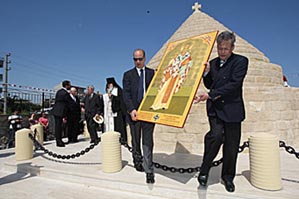 In
2008, at the initiative of private individuals in Russia and with the
help of the Russian Government, the monument was restored in its
original form and ceremoniously unveiled on May 17. A plot of land was
dedicated for it surrounded by a fence, and a memorial museum
containing photographs, pictures and a krasniy ugol ["beautiful corner" with icons].
In
2008, at the initiative of private individuals in Russia and with the
help of the Russian Government, the monument was restored in its
original form and ceremoniously unveiled on May 17. A plot of land was
dedicated for it surrounded by a fence, and a memorial museum
containing photographs, pictures and a krasniy ugol ["beautiful corner" with icons].
Representatives of the Russian
Diaspora were invited to the unveiling ceremony: members of the Society
of the Descendants of Gallipoli, who brought with them a painted icon
of St Nicholas, Archbishop of Myra in Lycia the Miracle-worker, the
Protector of the White Army. The icon bears the following
inscription:
"To the glorious people
of Gallipoli, the heroes of the White Army and all the warriors who
laid down their lives for the Homeland, tortured and killed in the
time of troubles and to those who died in peace, Eternal Memory!
Glory and honor to the Knights of Gallipoli! You shall always be our
pride! The children, grandchildren and great-grandchildren of the
People of Gallipoli, 17-05-2008."
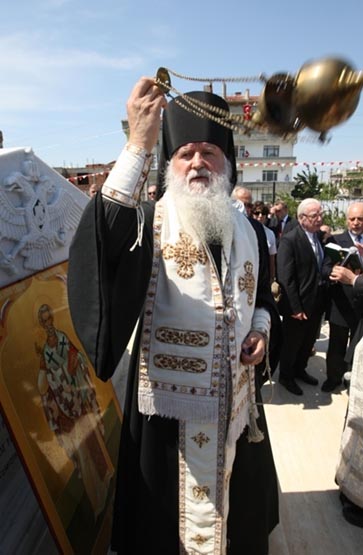 A
delegation of 30 descendants of the people of Gallipoli attended the
opening. The icon and monument were unveiled on May 17, 2008, in the
presence of His Grace Bishop Michael of Geneva and Western Europe and
His Grace Bishop Mark of Egoriev. A male choir from among the
descendants of the Russians of Gallipoli sang at the opening and
pannikhida that followed under the wonderful direction of Andrei
Konstantinovich Malinin.
A
delegation of 30 descendants of the people of Gallipoli attended the
opening. The icon and monument were unveiled on May 17, 2008, in the
presence of His Grace Bishop Michael of Geneva and Western Europe and
His Grace Bishop Mark of Egoriev. A male choir from among the
descendants of the Russians of Gallipoli sang at the opening and
pannikhida that followed under the wonderful direction of Andrei
Konstantinovich Malinin.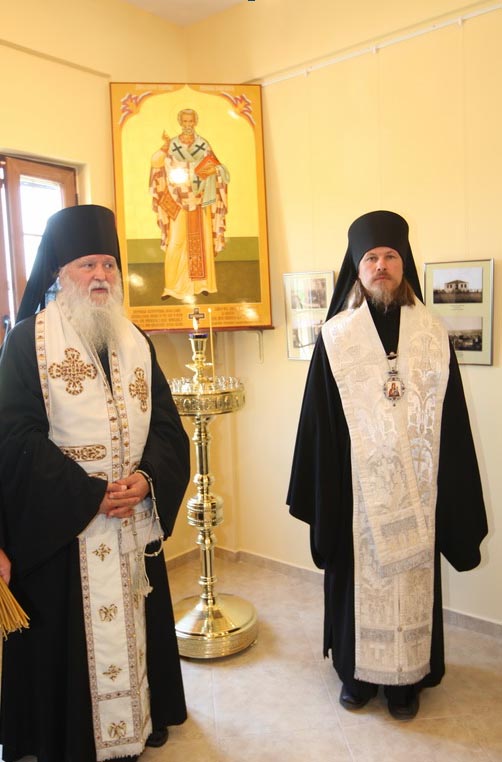 After the pannikhida, the icon was taken in a procession of the cross under the singing of Christ is Risen
to the icon corner of the museum and placed their on an analogion with
a burning lampada and lit candle. After the prayers, the choir sang
the Hymn of the White Army, Kol' Slaven [Glory to Our God].
After the pannikhida, the icon was taken in a procession of the cross under the singing of Christ is Risen
to the icon corner of the museum and placed their on an analogion with
a burning lampada and lit candle. After the prayers, the choir sang
the Hymn of the White Army, Kol' Slaven [Glory to Our God].
The following day, the
delegation was invited to a reception and concert with dinner at the
Russian Consulate in Istanbul, where the Russian Consul and his wife
warmly welcomed them.
During dinner, the President of
the SDG, Alexei Pavlovich Grigoriev, gave a speech thanking the
organizations participating in the reestablishment of the monument, the
members of the Russian Diplomatic Corps, the clergymen of the Russian
Orthodox Church Outside of Russia and of the Ecumenical Patriarchate.
He expressed the notion that it is the fervent love for Russian
imparted to us by our fathers and grandfathers that unites us
spiritually and binds us to the citizens of the Russian Federation,
who are seeking our common roots and our common history. The
delegation then sang the Alexeev Regiment March, after which
the Vice President of the SDG, Maria Nikolaevna Apraksina, daughter of
the Personal Secretary of General Wrangel, NM Kotliarevsky, also
expressed her thanks and shared her personal memories of the figures
of the White Movement in the diaspora.
So a monument to the White
Warriors of Gallipoli stands again, and one can once again pray for them
and light a candle to their protector, St Nicholas.
Glory to God!
Sergei S Tarasov
President, French Department of the
Society of the Descendants of Gallipoli
Paris, May 22, 2008
President, French Department of the
Society of the Descendants of Gallipoli
Paris, May 22, 2008
http://www.turkey.mid.ru/hron/pr_e_07.html
|
 |
|
|
|
|
|
||
| ||


